A tool that makes your lunchtime be the best time!

Just like at our homes, food brings us together to share joyful moments of food experiences. Eating together helps create relationships that are truly essential in a workplace.

Today, we want to share with you a tool we have created to order food in a simpler way, together with our teammates. We are sure that anyone who is reading this blog relates to the challenges of choosing where to eat, what to eat, how to order. In addition to that, let’s not forget the enormous time consuming of collecting everyone’s orders, money changing, etc. 

This life-saving tool makes the ordering process smooth and enjoyable for everyone. It saves time; calculates the change for everyone;  reduces the “what should we eat” noises in the offices, and most importantly; it brings efficiency between staff.

The problem

When we want to decide what to eat or drink, the process of getting everyone’s order always feels like an infinite loop until everyone decides on their order. Also, there is the part where we need to write what everyone ordered, the amount of money they’ve added, and their change. 

The Solution 

We’ve found this very time-consuming so we’ve decided to build a tool that helps to shorten this process.

We present to you this tool that simplifies the ordering process inside a small or large team. The flow of ordering looks like this: 

Add new order:

  • Decide the order name.
  • Set up the time frame until the order is active.
  • Select the location where you will make the order.
  • Send the link to your teammates.

Order review

  • After everyone decides what to order, the bill of the products will be listed in the right sidebar. 
  • Put the amount of money you have and the change will be calculated directly. 

Summary

  • After deciding our order, you’ll be redirected to a summary page where everyone’s order has been listed. 
  • Copy the summary, make the order. 

This tool has helped us a lot in making the ordering process smooth and enjoyable for everyone. We are planning to share this tool with other companies who find it useful for themselves. For our internal use, we have named it “Kutia Porosia”, and we are suggesting that every company who decides to use this tool, choose an internal name that fits them best.

If you want to book a demo meeting, please contact us at: sales@kutia.net

How we built a cross-platform that supports creative writing!

Traditionally, creative writing and technology have not been very good friends. But, with technology being an essential part of our lives, it has come the time to focus on fostering creative writing in technology and help people find their comfort platform for their creativity to do the work! Sometimes, inspiration can seem to be a million miles away, with no hope of being reached. Thanks to the scores of the online creative writing apps that we are building, it doesn’t have to be that way anymore. 

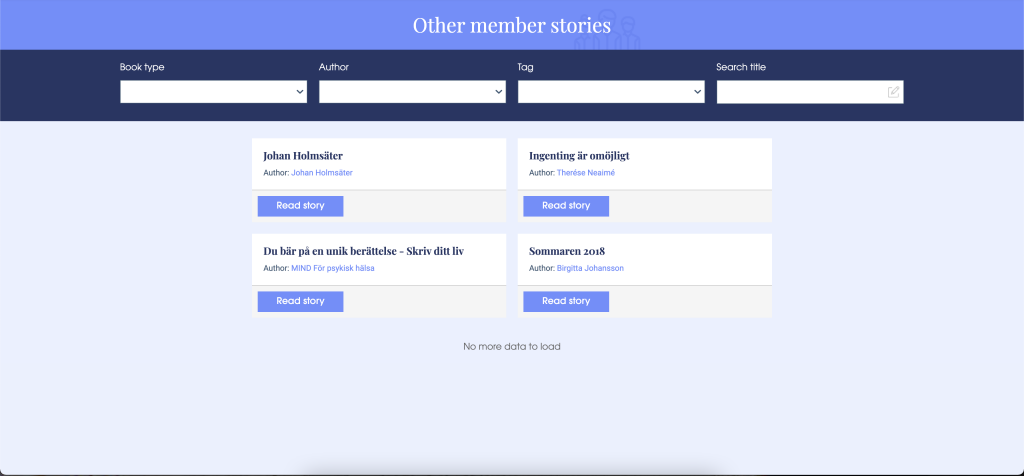
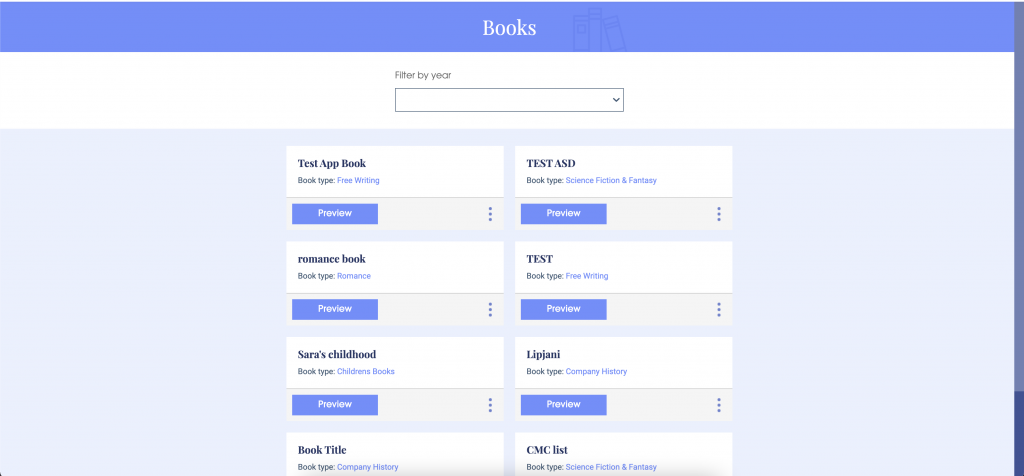
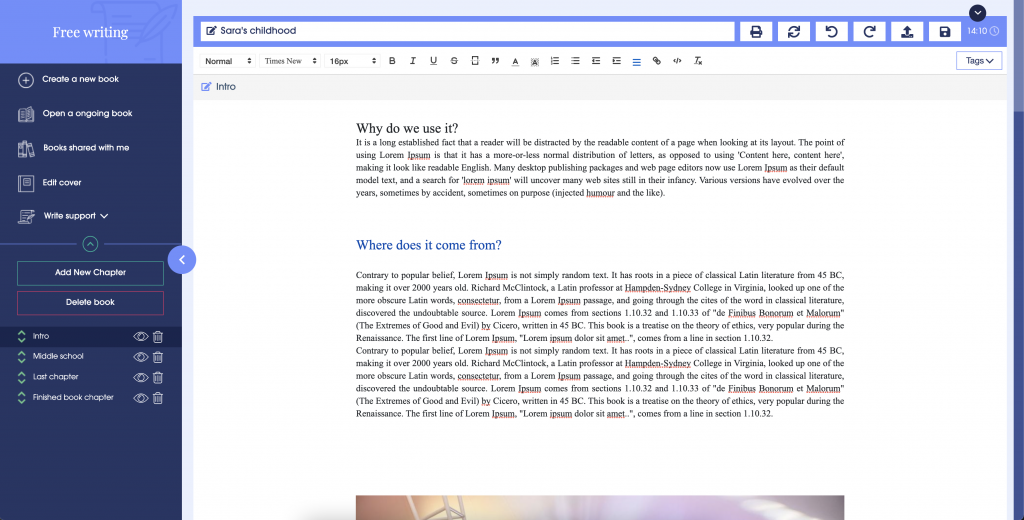
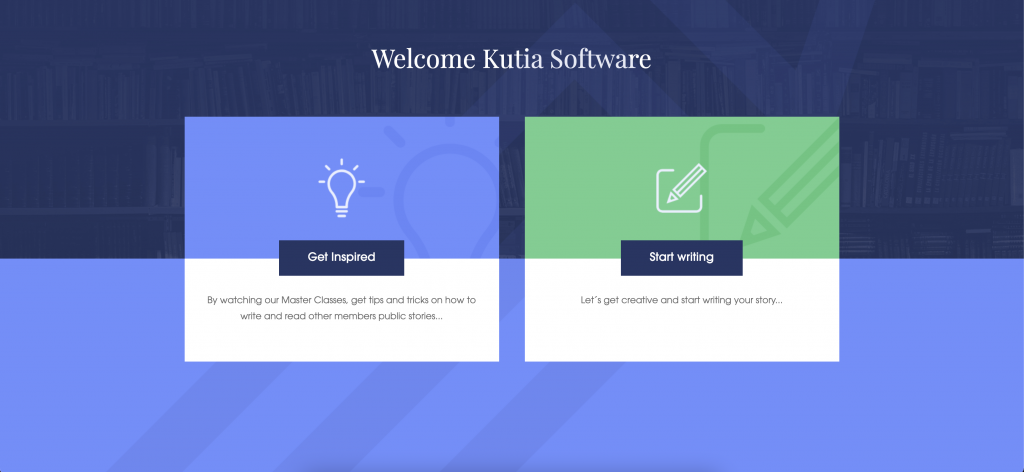
We want to share with you a great success story of building a cross-platform software for everyone to share their stories, their writings, and archive them for the future. This platform allows users to collaborate and write books based on chapters, add images, links, videos, and all content types. 

Our client’s request was to build a website where people can share their stories, write, create books, and archive materials for the future;  to be a place for everyone to feel comfortable and enjoy the interaction with other users and co-writers; to find passion and take a chance to become a writer. 

This website offers a lot of interesting features such as:

Master Classes
By watching our Master Classes hosted by teachers and authors, you will get tips and insights on how to improve your writing and storytelling.

Write
You can easily create your books and save them with your titles and tags. With a click, you can preview your books in a digital version and different sizes for print.

Invite co-writers
You can invite up to five co-writers to each one of your books. Type in their email address and an invitation will be sent to them.

Timeline
You can use the timeline function to create a timeline for your book, for a character in your book, or a company’s history.

Map
Add places around the world that you or someone else has visited at different times.

Hire writing help
Choose among our professional writing pedagogues. You can order help for an hour or a package price.

Invite guest readers
Invite unlimited guest readers to read your books on the app and website.

Make your book public
When you start writing your books are always private. If you want you can share your books with other members by making one or more books public.

Print
You can choose to print your books in three different sizes. It’s easy to create your cover at Picapen or upload a pdf as your cover.

Publish
When you finish your book, you can publish it on well-known e-stores with a few clicks.

Archive
This platform will be the archive for your books. Here you gather your texts together with pictures, videos, audio files, and documents.

Tech-stack

  • Nest.js Framework
  • NodeJS
  • API integration
  • Stripe Integration
  • Third-party API integration
  • PostgreSQL
  • Amazon Web Services (AWS)
  • Vue.js
  • Backend: Nest.js Framework
  • Database: PostgreSQL Web App
  • Frontend: React.JS Web App
  • Dashboard: Vue.JS Content
  • Management: WordPress (through WP API) 
  • Mobile App: React Native Book Reader: Vue.JS
  • Hosting Infrastructure and Storage: AWS Services External
  • APIs: Colibrio (For publishing/printing books)
  • Facebook API Stripe API

If you feel like it has come the time for you to use technology in creating the best creative writing platform, we are happy to help you!

Contact us at: sales@kutia.net and we will get back to you!

How we are building complex software solutions for an accounting company

DAS is a cloud-based platform that meets the needs of businesses and accounting agencies for programs and services that will help them to efficiently manage their finances.
In addition to popular programs for invoicing, accounting, inventory, payroll, and expense management, hundreds of industry-specific solutions from other suppliers are integrated into the platform.
What makes it really functional, is that everything you do is available everywhere and any time on only one platform. It is a perfect solution for collaborating with an accounting agency and sharing your work. It is very suitable even when you are traveling and want to work via the DAS app on your mobile phone.

Technology used

  • Docker and Docker Compose
  • Laravel
  • VueJS
  • SASS
  • Redis
  • Mysql
  • Webpack

File Structure

The image below is a structure of project files and folders in development mode:

Important files and folders

dockerthis folder contains docker containers
logsthis folder contains docker containers logs 
srcthis folder contains project
.envthis file contains environment variables for docker and pre-installation 
docker-compose.ymlthis file defining and running multi-container Docker applications
Makefilethis file is shell commands which makes it easy to start or stop the server
Source of projectDocker Containers

Project Structure

The structure of the project is shown in the picture above. The peculiarity of this structure is that the shared files with the project name “das” contain the project structure such as controllers, models, repository, services, etc. Due to the laravel upgrade, the peculiarity of this structure is different from the laravel structure. We have had such cases where the laravel structure has changed from version to version and this has affected the project or the organization of the project for browsing files.

Features

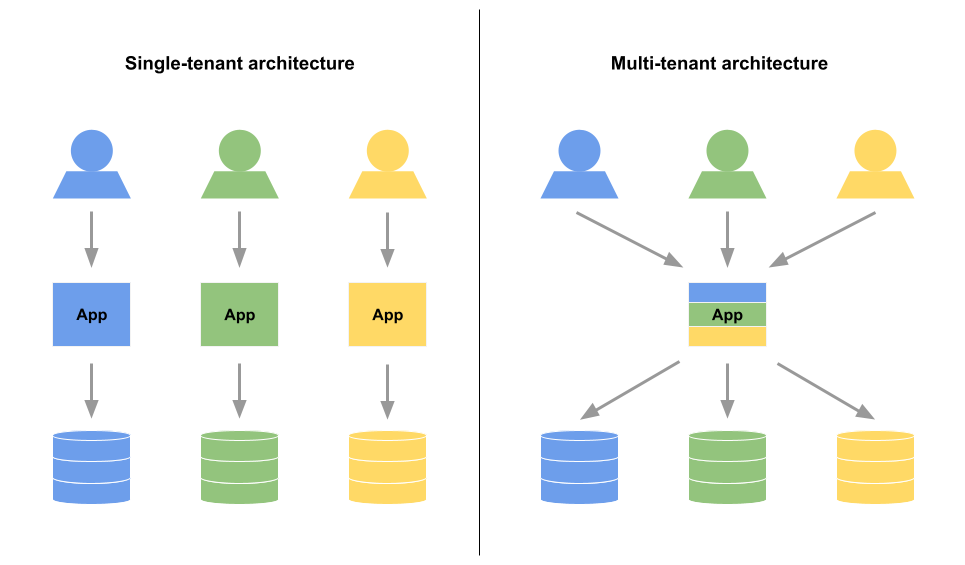
Multi Tenancy

DAS is a reference to the mode of operation of software where multiple independent instances of one or multiple applications operate in a shared environment. The instances (tenants) are logically isolated, but physically integrated.

Clean Code

Writing clean code is important because it allows you to clearly communicate with the next person who works with what you’ve written. Returning to previously written code and understanding what it does is key, especially in the software development world.

public function create(CreateVoucherRequest $request)
{
    return $this->apiResponse(
          __("Voucher has been created"), 
          $this->repository->create($request->validated())->toArray()
    )->asApiSuccess();
}

as seen above the code is clean and understandable.

Modular

This is what modular is trying to resolve. You split the business logic into different parts, which belong together. If you’re into Domain Driven Design, you can consider a module an aggregate. Every module has its own routes/controllers/models/views/business logic/etc. Meaning every module contains a group of classes that all are related to each other in some way.

Design Pattern

DAS is built with a design pattern that establishes solutions to common problems, which help keep the code maintainable, extensible, and loosely coupled. Developers have given a name to solutions that solve a particular type of problem.

namespace Das\Modules\Vouchers;

use Das\Database\TenantEloquents\Vouchers\Vouchers;
use Illuminate\Database\Eloquent\Collection;

interface VoucherTransactionServiceInterface
{
    /**
     * Set Voucher Model
     * @param Vouchers $model
     * @return VoucherTransactionService
     */
public function setModel(Vouchers $model): VoucherTransactionService;

    /**
     * Set Transactions
     * @param array $data
     * @return VoucherTransactionService
     */
public function setTransactions(array $data): VoucherTransactionService;

    /**
     * Create Voucher Transactions from data
     * @return Collection
     * @throws \Exception
     */
public function create(): Collection;
}
namespace Das\Modules\Vouchers;


use Das\Database\TenantEloquents\Vouchers\Vouchers;
use Illuminate\Database\Eloquent\Collection;
use Exception;

class VoucherTransactionService implements VoucherTransactionServiceInterface
{

    private Vouchers $model;
    protected array $transactions = [];

    /**
     * Set Voucher Model
     * @param Vouchers $model
     * @return $this
     */
public function setModel(Vouchers $model) : self
    {
        $this->model = $model;
        return $this;
    }

    /**
     * Set Transactions
     * @param array $data
     * @return $this
     */
public function setTransactions(array $data) : self
    {
        $this->transactions = $data;
        return $this;
    }

    /**
     * Create Voucher Transactions from data
     * @return Collection
     * @throws \Exception
     */
public function create() : Collection
    {
        // logic of code...
    }
}

Docblocks

DocBlocks are blocks of texts which are used to generate documentation using phpDocumentor, also known as phpDoc. Interestingly, they are very important to use when we developing a complex software product. In this case, everything must be documented.

How is a new tenant company created?

When a company that will create the multi-tenancy architecture is created, the client database is independent from the application database. This means that if a client experiences a data problem, it will not affect other clients.
Below you will find our how to create a company based on multi-tenancy.

These were some features of this platform.

Along with this project, we have some different challenges that Kutia has overcome to function properly. Unfortunatly, for authorial reasons, not all features can be published.

It has been a pleasure to share our solution with you. We are grateful for our back-end developer Sami Maxhuni, who worked on this project and made it possible for us to share it with you by putting all the work into words.

How we helped our client increase business profitability by digitizing his processes

We are continuously talking about the importance of digital transformation in almost every aspect of our lives, especially in business. Today, we want to share with you another success story. This is a concrete case of how our solution made a huge impact on our clients’ business growth. 

Our client turned to us to find a concrete solution that would help him manage his business operating in a distributed manner. He had various distributors throughout the country. Over time, he recognized a decrease in income and poor data management. The whole organizational and operational system needed a turnover. 

He came to us with a clear understanding of what his business needs. His goal was to have a clear overview of turnovers, reports on a daily and monthly basis, and a management tool for his employees. He wanted to see an overview of his business, not only in the financial aspect but also for other implications that may appear during the performance of tasks. To put it shortly, his request was for us to digitize his business for him to have more control over it.

We were happy to provide this solution by creating a platform that would help him in all processes. This solution had a 100% positive impact on transparency in cooperation with distributors and agents. At the same time, it reduced workload. 

The results were amazing! 

The reorganization of the processes during the digitalization influenced the increase of the annual profits by about 35%. 

How we did it…

We decided to initially compile a very attractive and effective distributed web application. We started by combining the necessary data and strengthening the cooperation between the consumer and the product owner.

Kutia Team made it possible for the main client to store everything in the CLOUD. This reduced the need of traveling from unit to unit and micromanage all levels of the well-functioning enterprise. The client would send all the needed data and requests to the server within and using this server, which would link to the Web Socket Server and back to the Administration Panel, Desktop Application, and Online Application.

The Administration Panel serves as a platform where units are created. There is filtration and productive generation of reports. The Desktop Application is the interaction between units and the consumer. Desktop Application accepts the request, forwards it to the server to see if all criteria are matched, and then produces real-time statistics.

Furthermore, Desktop Application has been created using ELECTRON JS.

Since consumers are an important part of our digital transformation process, we never forget to accommodate their needs using the best and up-to-date technologies.

The entire platform is used by approximately 3000 people per day, with around 280.000 monthly unique transactions performed without any issues during the process.

A lot of data is gathered into the building infrastructure process so that the communication gap between the client and consumers shall be reduced to a minimum. We engaged in this by maximizing the management of host data. Gathered data helps us improve the functionalities of the platform constantly.

We used all technical capacities and engaged fully in optimizing all the data and transforming this enterprise into a digital wonder.

Technologies we used:

Backend API: PHP Laravel 8, Redis (for Queue and Job management), MySQL database.

Administration Panel: PHP Laravel 8, Vue.js

Point Application: ElectronJs, Vue.js

Online Application: Vue.js SPA

The impact of web development & mobile apps on the education industry

Believe it or not, now is not the time to tell your kids to put their phones away and start doing their homework. The mobile applications have taken learning to the next level! With various features of educational mobile apps, we can get access to learning materials and much more anytime and anywhere.

We have already gone through the ways that technology is positively affecting a lot of industries, especially healthcare. From our experience of building productive websites and mobile apps for different schools, we want to share with you the benefits of web development and mobile apps in the education industry. 

These benefits are bringing a huge impact in the traditional education system by introducing the power of flexibility, personalization, and engagement into the processes. Something that is making it possible to learn even beyond the premises of schools, libraries, and other educational organizations.

In the classroom and outside the classroom, apps are providing higher efficiency and fun in learning or teaching. They are providing an ample amount of benefits to both students and educational institutions.

These benefits include:

1. Unlimited Learning

The most important benefit of learning with a mobile application is that you can have access to unlimited sources and knowledge. Information is not only limited to books.

2. Less Learning Cost

There are lots of courses which you can learn without joining any coaching center or learning institute. Hence, you can learn lots of things without paying any tuition fees.

3. Better Engagement Of Students

Textbook learning nowadays has become history, and students like to learn from the media and audio-video platforms. It lets students understand the concept at a faster speed.

4. Better Interaction Between Students And Teachers

Not only students but also teachers are getting enormous benefits from mobile applications. There are lots of mobile applications for teachers’ use, which can help them track their students’ performance, their grading history, and their attendance in a digital way.

Some online mobile applications allow teachers to update assignments online and from there, students can easily access their assignment and submit it as well there. Additionally, students can know the upcoming exam schedule and upcoming events without any hassle.

How to start?

The impact of mLearning is so significant that many educational institutes and schools have already begun to hire web & mobile application development companies. And, you just found yours!

We are highly experienced and excited to help you be a part of this revolution. We have already provided educational services that bring great convenience to students, teachers, and school management as well. With our M-educational services apps, students and teachers can access services at any time.

If you are interested in learning more about our services, feel free to contact us at: sales@kutia.net

How can I grow my business in 2021?

In our previous blog, How to start an online business in 7 simple steps, we have already gone through the most important steps you need to take in order to start an online business. We have also explained how Kutia handles this process smoothly and successfully. 

Now it is time for us to set goals of growth and see how the process is going. Even though there are some important things to keep in mind when aiming to grow your business, today we are going to specifically focus on the importance of “going digital”. First, let’s name some important things to keep in mind when you want to see your new business grow. 

1. Get to know your customers

2. Offer great customer service

3. Nurture existing customers and look for new opportunities.

4. Use social media

5. Attend networking events

6. Host events

7. Give back to your community

8. Measure what works and refine your approach as you go

“Go digital or go home”

When talking about digital transformation, we talk about using innovation and technology to push your business. It’s about finding new possibilities of an existing service in order to design and deliver a better experience for your customer. The world’s obsession with the latest technology, social media, and apps revolve around a desire for an easier life. People want valuable solutions to their problems. More importantly, they want it fast. As a result, the primary focus of digital transformation is to use cutting-edge technology to improve the customer experience.

Technology has always been viewed by companies as a support tool, as something to improve productivity rather than seeing it as an active driver, a fundamental aspect of business that is intrinsically linked to innovation. This view, however, has changed dramatically as the Internet, mobile devices, and connectivity have become more interlinked. To put it simply;  if we don’t find something on Google, we assume it doesn’t exist. 

Through building a digital process at an early stage and integrating the wider organization with technology, businesses stay ahead of the curve and make themselves more available to future partners. Internal processes can become more efficient and flexible, with the ability to scale as the business grows. Over time, digital transformation produces the tools to generate time and resource gains, strengthening business partnerships.

But, even organizations that are well on the road to digital transformation face tough obstacles such as budgets, finding talent and cultural changes. That is why you need a serious software development company to run this process for you. You’re hearing “digital” everywhere you go; digital technologies, digital data, digital media, digital transformation, digital marketing. Everyone wants to go digital. 

But, which way to go?

Here at Kutia, we experience innovation in practice and believe in remote and freelance work as a key to this digital transformation. This makes us the best fit for making your business see that desirable growth. Digital transformation is our specialty. 

Get started today by contacting us at: sales@kutia.net

Improving Work-Life Balance Through Time Management Skills

More than ever, the phrase “business hours” is devoid of meaning. During the pandemic, “business hours” has morphed into “any hours” or, more precisely, “all hours”. 

Work-life balance is an important aspect of a healthy work environment. Maintaining a work-life balance helps reduce stress and helps prevent burnout in the workplace. By creating a work environment that prioritizes work-life balance, employers can maintain a healthier, more productive workforce. Accordingly, we should see this process as a cycle, not an achievement. 

The team’s work-life balance is the responsibility of both leaders and individuals. It is important for both parties to collaborate and find the best solution for everyone to enjoy their time – both at work and home. 

We are sharing with you some interesting time management skills that we find helpful to improving the work-life balance. 

“Who has the time to plan?”

That is exactly what everyone thinks when hearing the phrase “ Plan your day ahead”. Well, we don’t realize how important planning is. Instead of approaching your day in a haphazard manner and feeling like you hardly managed to get anything done by the end of it, planning boosts efficiency and productivity.

Make it a habit! Spare some minutes of your afternoon to make a quick plan of tomorrow’s workflow. Decide the important things you need to get done at the beginning of the day and things you want to do when you get home.

Put first things first 

Learn to say “no”. Sticking to your priorities is a key to maintaining a healthy work-life balance. It is important to stand up for things that matter to us without feeling guilty. Try to finish the tasks you were given and remember the feeling of leaving work without thinking about those deadlines. This will give you more time to enjoy with your family or friends.

Wake up early

It sounds very traditional. That is because it is the most effective and natural way to manage the day. Being an “early bird” positively impacts our health and productivity which makes it completely worth it.

Turn off notifications & leave on reminders 

The constant reminders from social media, instant messenger, and other apps take time and focus away from what you are currently doing.  The instant you look at the pop-up notification, you have lost much more time than you realize, because it takes more time for your brain to focus on your current task.  On the other hand, the reminders regarding meetings and action items can be a helpful tool to help you meet deadlines and be on time.

Turn off work mode when you’re home

Are you constantly checking your work emails on the dinner table or thinking about an upcoming work presentation when you should be sleeping? Work has clearly invaded your life and you need to learn how to switch off. 

After a long day at work, you should spend quality time with your family or enjoy some alone time. That does not mean being physically present but mentally absent. It means to be truly invested in your family’s life and do meaningful activities together.

“Health is wealth” 

As cliché as it sounds, there is no greater truth than that. There is no way you can excel at work or home if you aren’t physically and mentally fit. Regardless of how busy or overworked you are, you need to take care of yourself by drinking 2-3 liters of water, getting at least 7-8 hours of uninterrupted sleep, having a balanced diet, and exercising regularly.

7 Tools & Libraries every Software Developer should learn

When working in software development, you’re always learning something new, evolving your skills to keep pace with innovation. 

Through the years being in the software development business, we had the chance to work with companies in different sectors on hundreds of projects. It wasn’t always easy. We went through countless challenges, both technical and cultural, and learned lessons that can’t be taught in a classroom.

We want to share with you the top 7 tools and libraries that every software developer should learn. Good knowledge of these tools goes a long way in your software development career.

1. Git [Version Control]

Git is a Version Control System (VCS). On a very basic level, there are two awesome things a VCS allows you to do. You can track changes in your files and it simplifies working on files and projects with multiple people. There are multiple Version Control Systems, but Git is by far and large the most popular. Both for individual and company use.

If you are a beginner or a programmer and want to improve your Git knowledge, we suggest you go check out the Git Complete: The definitive, step-by-step guide to Git course from Udemy.

2. Docker

Docker is another important tool that every programmer and software developer should learn. It makes your development easy as you don’t need to install many separate applications. Just downloading a Docker image with the required software is enough. 

Docker is also becoming a standard tool for deployment as more and more teams are adopting Docker to deploy Microservices and other Cloud Native apps in a consistent manner. The main advantage of Docker is that you can deploy a Java Microservice or a C++ app in the same way because you actually deploy a Docker container. 

If you want to learn Docker and need a resource, we recommend Docker and Kubernetes: The Practical Guide by Maximillian Scwarzmuller on Udemy. A great hands-on and affordable course to learn both Docker and Kubernetes in 2021. 

3. Linux Commands

Since most programmers have to work on Linux machines at some point, good knowledge of the Linux command line goes a long way.

It allows you to work effectively. You can search files, know what’s going on with the system by checking its CPU and memory usage, and perform basic and advanced tasks.

If you want to learn Linux commands, we suggest going through Learn Linux in 5 Days and Level up your Career course on Udemy.

4. Postman

Postman is an API (application programming interface) development tool that helps to build, test, and modify APIs. Almost any functionality that could be needed by any developer is encapsulated in this tool. It is used by over 5 million developers every month to make their API development easy and simple. It has the ability to make various types of HTTP requests (GET, POST, PUT, PATCH), saving environments for later use, converting the API to code for various languages (like JavaScript, Python). 

If you want to learn the Postman tool and you are looking for some excellent resources, we recommend Postman: The Complete Guide course on Udemy.

5. AWS [Cloud Platform]

AWS (Amazon Web Services) is a comprehensive, evolving cloud computing platform provided by Amazon. It includes a mixture of infrastructure as a service (IaaS), platform as a service (PaaS), and packaged software as a service (SaaS) offerings.

AWS offers many different tools and solutions for enterprises and software developers. They can be used in data centers in up to 190 countries. Groups such as government agencies, education institutions, nonprofits, and private organizations can use AWS services.

If you want to learn AWS, there is no better time to do so than right now. There are plenty of opportunities for employment or to start your own business if you have AWS certification. Here you can find some amazing courses where you can learn from real-time experts.

6. JIRA

Jira Software is part of a family of products designed to help teams of all types manage work. Originally, Jira was designed as a bug and issue tracker. Today, Jira has evolved into a powerful work management tool for all kinds of use cases. From requirements and test case management to agile software development.

The platform leverages all kinds of project management skills, including software development, agile project management, bug tracking, scrum management, content management, marketing, professional service management, and much more. 

Learning JIRA is also a good way to progress in your career. As you grow and become a team lead or tech lead, you will get more responsibilities. JIRA can help you there. If you want to learn JIRA, we recommend Learn JIRA with real-world examples (+Confluence bonus) course on Udemy. 

7. VS Code [Code editor]

Visual Studio Code is a streamlined code editor with support for development operations like debugging, task running, and version control. It aims to provide just the tools a developer needs for a quick code-build-debug cycle and leaves more complex workflows to fuller featured IDEs, such as Visual Studio IDE.  

Software developers do a lot of text processing jobs and knowing a text editor will always help. Apart from NotePad, which is a very good, omnipresent basic text editor, we encourage programmers to learn some advanced text editors like Sublime or NotePad++. But, if you know VS Code, then you can do advanced text searching, replacement, and even run macros. 

If you want to learn more about the VS Code, we recommend you to join the Learn Visual Studio Code 2021 course on Udemy. It’s a great course to not only learn basic VS code but also advanced tips, tricks, and shortcuts to boost your productivity.  
Why is Technology Important in Healthcare?

Telemedicine has become a concrete example of how we are reshaping the way we interact with healthcare professionals, how our data is shared among providers and how decisions are made about our treatment plans and health outcomes.

It is true that the pandemic situation of Covid-19 has played a huge role in this transformation. However, patients have already started to turn their heads to telemedicine years ago. Covid 19 was actually just an impact to push this process forward. 

The latest studies are showing that patients are turning into virtual healthcare. That is why software solutions are becoming a great tool to serve this process. Thanks to technology, patients get better treatment with virtual reality tools, wearable medical devices, telehealth, and 5G mobile technology. On the other hand, doctors can streamline their workflows using artificial intelligence-powered systems.

The question is: How can we offer telemedicine solutions and in return receive added value and lower costs? 

Kutia has the solutions and experience to help healthcare systems thrive in an ever-changing healthcare environment. These benefits include reduced pressure on hospital emergency departments, more efficient allocation of healthcare resources, and thus patient experience. We have been further developing telehealth solutions by extending digitalization to transform care delivery. 

In our previous blog: “Why do hospitals need to digitize their processes”, we have already discussed the way technology is helping hospitals and doctors in their patient-management process.  

Some of the main reasons why hospitals need to digitize their processes are:

  • Easier access to patient records
  • No papers (helping the environment too :))
  • Easier collaboration between departments
  • Improved efficiency
  • Increased accuracy
  • Patient satisfaction
  • Faster services

How can we help you?

With the purpose of expanding the access to healthcare through technology, there are some important areas we pay attention to:

  • Enabling patients
  • Empowering workforce
  • Upgrading infrastructure
  • Optimizing workflows
  • Protecting data

If you feel like it has come the time for you to use technology in managing your healthcare services, we are happy to help you.

Contact us at: sales@kutia.net and we will get back to you!

How To Start An Online Business in 7 Simple Steps

Online businesses are changing the way we live. The huge impact of e-commerce and online business is driving our digitally connected lives. They have changed our purchasing behavior, our consumption habits, as well as our ways of communication. As online shopping begins to expand, people are starting to see the potential of online businesses. 

If you’re thinking about starting your own online business, this blog will take you through the 7 simple steps to successfully make your dream come true!

1. Find a need to fill

Initially, the purpose of your online business is to provide a product or service that people might be interested in. To do that, you need to do your research and some online market analysis first: 

  • Visit online forums to see what questions people ask and what problems they’re trying to solve.
  • Do keyword research to find keywords that a lot of people are searching for.
  • Check out your potential competitors by visiting their sites and taking note of what they’re doing to fill the demand. 
  • Use what you’ve learned and create a product for a market that already exists. 

2. Craft a business plan

After analyzing your targeted market, it is time you understood the type of website you need. Now, you need a business plan that will help you to set your goals and the measures you need to take to achieve those goals. Add information about your target audience based on your market research. When you sort out everything you need, you will find it easy to work out on your to-do list. Involve information about finances and the resources you will need to accomplish each step.

Your business plan should focus on two important things:

  • Explain why your business idea is good.
  • Provide a roadmap to turn your business idea into something that can be executed.

3. Choose your platform

You can choose the platform depending on how much server space you require, how quickly you want to access the website, or how secure you want your website to be.

4. Build your website

This is the most important step of starting your online business. This is where all your ideas & plans come to life. Take time to make your website right and perform customer surveys to receive feedback about your products and service. Make sure the website design is well-aligned with your overall visual branding. 

If you don’t have experience in building your website, don’t worry. We’ll help you build a scalable, secure platform that will guide your buyer through a seamless purchasing process. Our team will advise you on the platform infrastructure and server management. We’ll make sure you know how to optimize costs and scale in an optimal way. 

5. Stock up on Inventory

Inventory management involves ordering, stocking and using a business’s materials or products. You need to prioritize your inventory in order to understand what you need to order or manufacture more frequently so you can continuously fulfill your customers’ needs. By effectively managing your inventory you can have the right products in the right quantity on hand and avoid products being out of stock and funds being tied up in excess stock. 

6. Set up a marketing plan

Marketing is the voice of your business. If you don’t have a marketing plan, you cannot be heard or seen! To create it, you need a combination of content marketing, social media marketing, and paid search engine promotion. People use the internet to find information about your store. Your job is to bring that information to people. By building up your target market’s anticipation of your launch through social media and various advertising methods, you will be paving the way for a successful launch.

7. Launch your business

Get ready for your big day! It is time you tell the world about your new online business. Start by announcing the launch officially on social media, and commence your marketing campaigns. Even though it feels like the end of the process, it is actually just the beginning. You should start preparing yourself to issue orders and tackling any questions that arise. 

Take your first step in starting your online business by contacting us at sales@kutia.net

We take care of the rest!

Let’s start building connections_

Get in touch

Let’s work together Let’s work together